The ban is not a counter-narcotics victory and will have negative economic and humanitarian consequences, potentially leading to a refugee crisis.The Taliban have done it again: implementing a nearly complete ban against cultivation of opium poppy — Afghanistan’s most important agricultural product — repeating their similarly successful 2000-2001 prohibition on the crop. But the temptation to view the current ban in an overly positive light — as an important global counter-narcotics victory — must be avoided. This is particularly true given the state of Afghanistan’s economy and the country’s humanitarian situation. Indeed, the ban imposes huge economic and humanitarian costs on Afghans and it is likely to further stimulate an outflow of refugees. It may even result in internal challenges for the Taliban itself. And, in the long run, it will not have lasting counter-narcotics benefits within Afghanistan or globally.
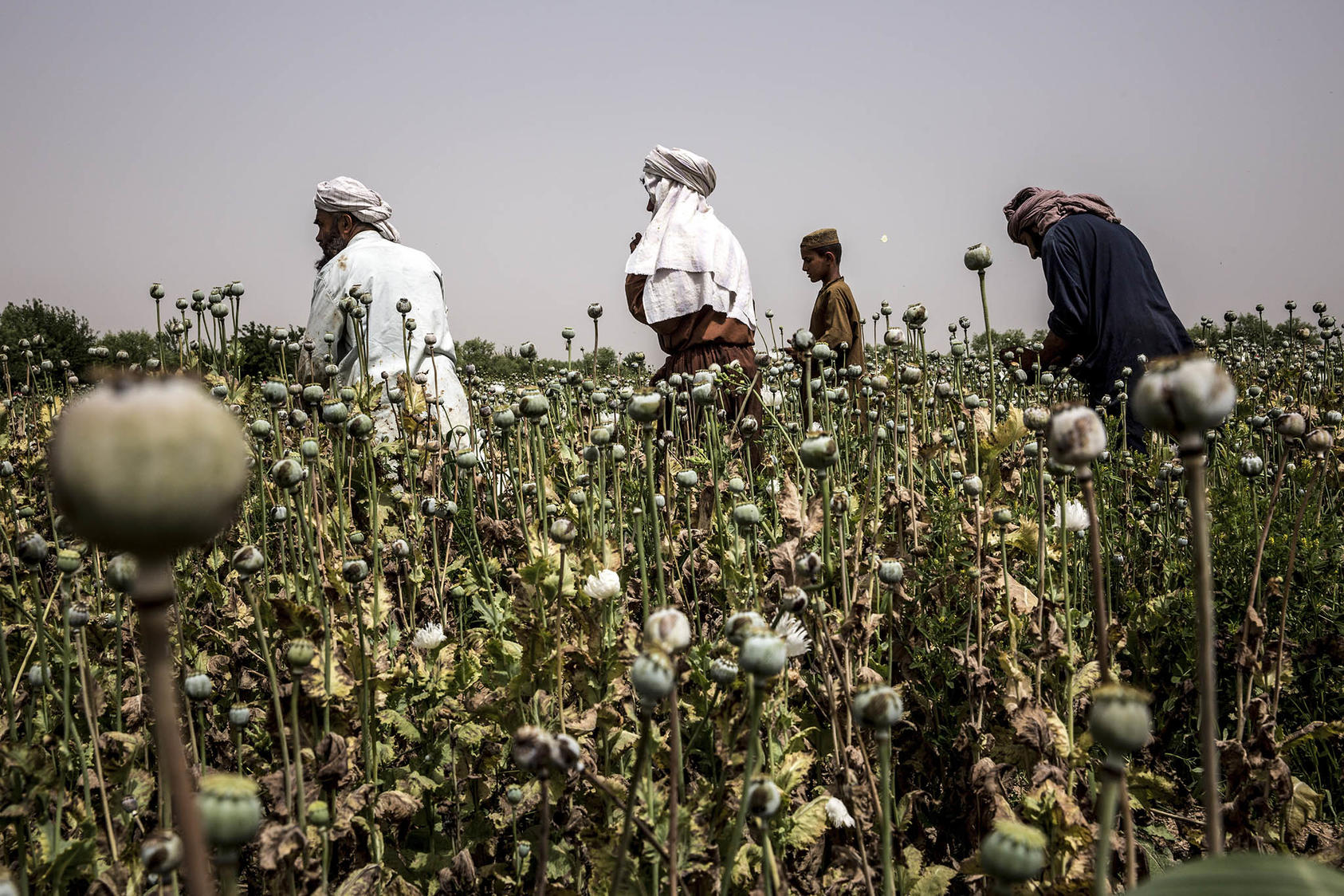
Phasing out Afghanistan’s problematic drug economy will be essential over the longer term — not least to contain widespread addiction within the country. But this ban, lacking any development strategy and especially at a time when the economy is so weak that displaced opium poppy farmers and workers have no viable alternative sources of income, is not the right way to start on that path.
The Taliban’s Highly Successful Opium Ban
Satellite imagery analyzed by Alcis and associated research by David Mansfield, an independent researcher who has conducted extensive fieldwork and analysis on Afghanistan’s opium sector and rural economy for more than a quarter-century, show that the Taliban opium ban, announced in April 2022, has been remarkably successful in sharply reducing opium poppy cultivation. In Helmand, by far Afghanistan’s largest opium-producing province, the area of poppy cultivation was cut from over 129,000 hectares (ha) in 2022 to only 740 ha as of April 2023. The reduction in Nangarhar, another long-standing opium producing province, is also impressive — only 865 ha this year compared to over 7,000 ha in 2022.
This is the pattern more broadly in south and southwest Afghanistan. Reductions in other provinces such as Badakhshan will be more limited, but these areas produced much less opium in the first place. Though the full picture is not yet clear, Afghanistan may approach the 90 percent reduction in cultivation achieved during the Taliban’s previous opium ban in 2000-2001. This is an undeniable achievement, particularly given the much larger size of the opium economy this time around (an estimated 233,000 ha in 2022 versus some 82,000 ha in 2000).
How was the ban implemented so successfully? As Mansfield argues, the Taliban took a relatively sophisticated, staged approach that evolved and intensified over time. The announcement of the ban was not accompanied by eradication of 2022’s bumper crop of poppy fields that were about to be harvested, which would have met fierce resistance. This gave rise to uninformed speculation that the ban was not serious. The Taliban did engage in eradication of the much smaller spring and summer crops subsequently planted in 2022, intended to deter others.
There were also major efforts during 2022 to crack down on ephedra, the main ingredient for Afghanistan’s thriving methamphetamine industry. These actions sent strong signals to the rural population in advance of the fall 2022 planting season, which, along with outreach and threats, effectively deterred planting of opium poppy in the south and southwest of the country. As a result, the bulk of the reduction in poppy cultivation reflected people not planting in the first place, and this was complemented by eradication of some remaining poppy fields soon after planting.
Unlike the Taliban’s previous opium ban, the current ban encompasses trade and processing of opiates, not just poppy cultivation. But just as the standing 2022 winter crop was exempted from eradication, it appears that trade in opium produced in 2022 and earlier has been allowed to continue. With the sharp decline in opium poppy cultivation for this year’s harvest, the bulk of ongoing trade must be in the ample supplies of “older” opium (UNODC estimated that Afghan opium production was 6,800 metric tons in 2021 and 6,200 metric tons in 2022). It remains to be seen whether this is a temporary dispensation or will be more permanent. In 2000-2001, trade in opiates was never hindered.

 A Unity Consciousness World